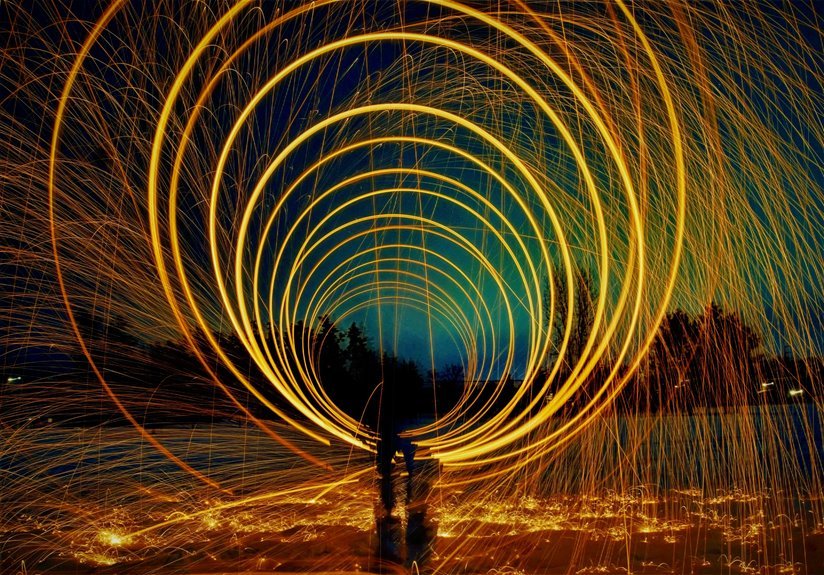
You’re likely aware that pulsars are fascinating cosmic entities, yet the Innerlight Chart offers a unique lens through which to analyze their characteristics. By examining data points like 893185650 and 1612336953, you’ll uncover significant trends related to their rotation speeds and magnetic fields. This understanding could lead to new insights about their role in the universe. But how does this knowledge intersect with the broader implications for space-time and gravitational waves?
The Nature of Pulsars
Pulsars, the remarkable remnants of supernova explosions, represent some of the universe’s most intriguing phenomena.
You’ll find that pulsar formation occurs when a massive star collapses, creating a highly magnetized neutron star. These objects emit intense radiation patterns, which you can detect as regular pulses.
Their unique characteristics provide insights into fundamental physics, challenging our understanding of space and time while offering a sense of cosmic freedom.
Analyzing the Innerlight Chart
The Innerlight Chart provides a detailed representation of distant pulsars, showcasing their various characteristics and behaviors.
By closely examining the chart, you can discern pulsar characteristics such as rotation speed, magnetic field strength, and emission patterns.
Accurate chart interpretation allows you to identify trends and anomalies, ultimately enhancing your understanding of these celestial objects and their role in the broader universe.
Insights Into Space-Time and Gravitational Waves
As you delve into the connections between distant pulsars and the fabric of space-time, you’ll uncover fascinating insights into gravitational waves.
These cosmic signals reveal the gravitational effects of massive celestial bodies, allowing you to trace distortions in space-time. Analyzing these phenomena enhances your understanding of how pulsars interact with the universe, ultimately deepening your grasp of fundamental physical laws.
The Future of Astrophysics and Distant Pulsars
Exploring the intricate relationship between gravitational waves and distant pulsars offers a glimpse into the future of astrophysics.
You’ll witness advancements in pulsar communication, enabling precise cosmic navigation. These pulsars act as cosmic beacons, helping us map the universe’s structure.
As we refine our techniques, the potential for interstellar exploration and understanding fundamental physics expands, revolutionizing our approach to the cosmos.
Conclusion
As you delve into the Innerlight Chart, envision the pulsars spinning like cosmic lighthouses, their beams slicing through the dark expanse of space. Each data point you analyze reveals the intricate dance of gravity and time, shaping our understanding of the universe. By unlocking these celestial secrets, you’re not just studying distant stars; you’re grasping the very threads of existence. The future of astrophysics lies in your hands, where every pulsar holds the promise of new discoveries waiting to illuminate the night sky.